Showing posts with label pork belly. Show all posts

Saturday, 24 July 2010

Finding the time

Hi all,
My time as restaurant chef has ended. My replacement started this week. Welcome Matt and Cinthia from New York!! Here's a couple of dishes i managed to squeeze in.
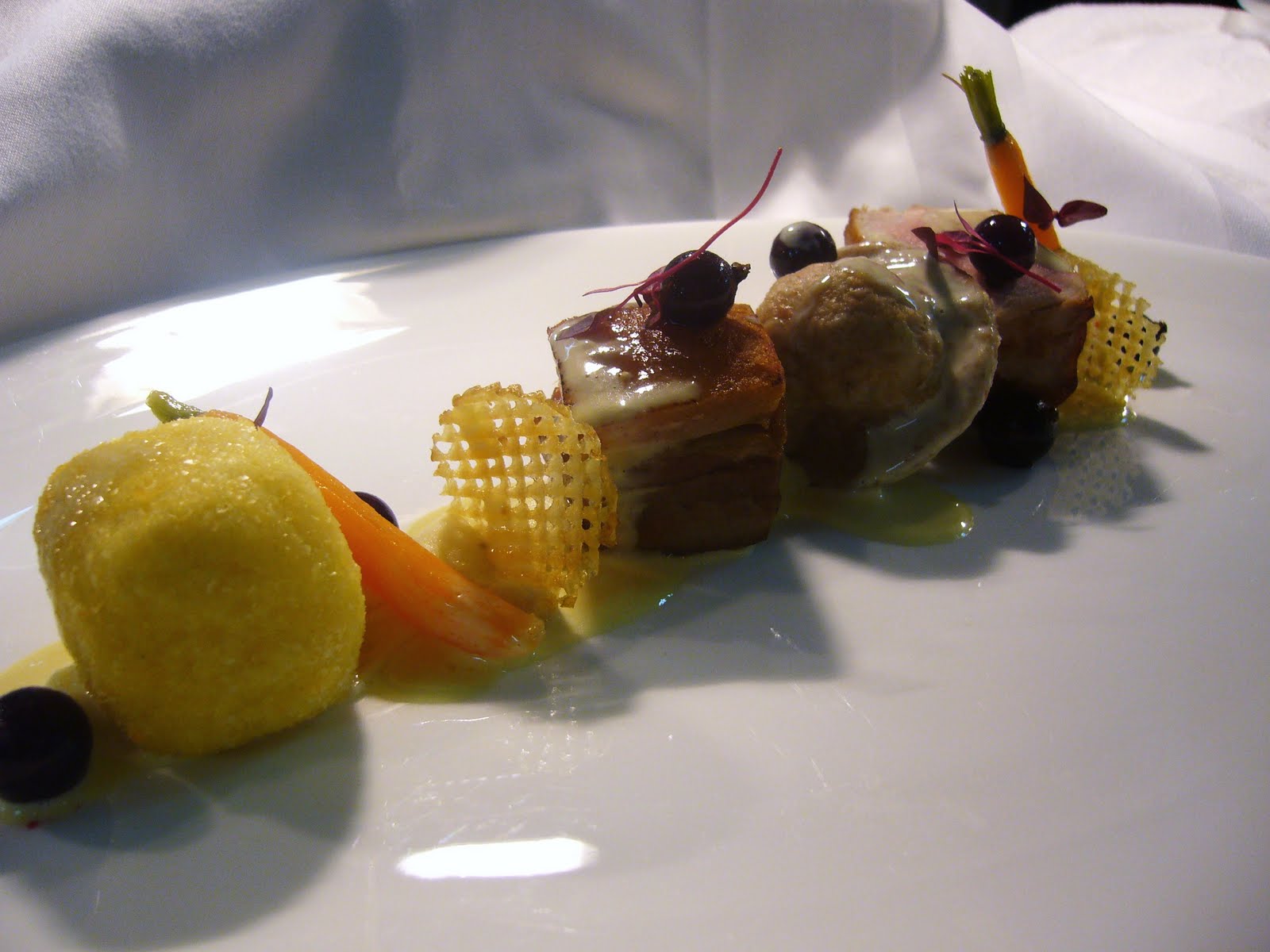


Roasted loin and confit belly of pork,
multiple potato preperations, blackcurrants, light foie gras sauce
( gauphrette, mousseline, aligot beignet, potato agnolotti)

Sous vide wild sea trout (12 mins @ 50C)
horseradish sour cream, red beetroot caviar

Thursday, 22 October 2009

Slow roasted pork belly, honeymead soaked apricots, cepe mushroom, pecan jus

Here is a dish iv'e just finished. Very simple and very seasonal. The apricots are soaked in a home made honey mead. Im loving this old English honey wine and have been using it to sweeten things up in certain dishes. Its been used for pickling, marinating, ice cream, sauces, glazing, jelly, cocktails.


Ingredients
  • 6 to 8 kilograms of grade-A honey
  • 20 lt of tap or bottled water
  • 8 grams (1/4 ounce) of freeze-dried wine, champagne, or dedicated mead yeast

Method

Making mead requires essentially the same basic kit necessary to brew beer at home: primary and secondary plastic-bucket fermenters with air locks and spigots, transfer hosing, a bottle-filler tube, heavy bottles, bottle caps, bottle capper, and a bottle brush and washer.

Bring the water to a boil. Boiling should remove harsh chlorine from municipal tap water. If you don't own a pot large enough to hold five gallons of water, boil as much as possible. You will add the remaining water to the fermenter later.

Once the water reaches a boil, remove it from the heat and stir in all of the honey. Do not boil the honey, as it reduces the aromatic quality of the finished mead.

While the honey dissolves in the water, put a cup of lukewarm water into a clean bowl. Sprinkle in the yeast and cover the bowl with plastic wrap. When the honey has been fully dissolved in the water and the pot is cool to the touch , pour the honey-water into the fermentation bucket and stir in the yeast mixture. Note: Cooling the honey-water could take quite a while. This process can be accelerated with a so-called sink bath, that is, repeatedly immersing the pot in cold water in a sink or basin.

If you have not already added the full 4 1/2 gallons of water, top it off with the balance in bottled water .

Seal the bucket and allow the mixture to ferment for two weeks to one month. The progress of fermentation can judged by monitoring the carbon-dioxide bubbles escaping from the air lock: When they drop to one bubble every sixty seconds, fermentation has nearly concluded. Note that is only an issue during this primary fermentation; secondary fermentation has more to do with aging and mellowing and hence is more flexible. When primary fermentation has subsided, siphon the mead over to your secondary fermentation bucket and seal it. Allow one to four months aging time. Do not open the fermenter, as this risks contaminating the mead.

When you decide it has matured enough (and the mead has cleared), you will want to siphon it into sterilized bottles and cap them. Follow the same procedure as you would for home-brewed beer.

This recipe is a basic mead. You can add different spices or play with elderflowers or add fruit flavours to your mead. It all depends what you want to use it for.

Sunday, 6 September 2009

Some dishes from this week.........

Strawberry gazpacho, seared scallop, crayfish and sushi rice
This was an amuse bouche, that was very refrshing and light.


Duck egg souffle, grilled puffa mushroom, tomato fondue, soya cream
With the egg we whipped the whites and placed the egg yolk into the centre. Wrapped in climg film, then steamed. The puffa mushrooms grow wild on the estate, they are like a huge ball, have a mild taste and soft texture. The soya cream is reduced soy sauce, sugar and double cream.


Cured mackerel, pink grapefruit, spiced bread, basil cous cous, red veined sorrel
We had some top quailty mackerel this week. Lightly cured in sugar and salt, baked with olive oil.


Assiette of Saddle back pork, caramelised Dogmersfield orchard apples, potato mousseline
The assiette is crispy ears, roasted loin, apple jelly glazed belly, braised cheek croquette.

Tuesday, 21 July 2009

Pork trio

This is a trio of pork that i had on the menu last week. There is a roasted and glazed belly sitting on puy lentils, sous vide poached loin topped with a grated red beetroot ball, braised shoulder with pan roasted apricot, candy beet and crackling.

Wednesday, 10 June 2009

This weeks du jour menu

Warm beetroot soup with sour cream and saffron floating island
Hampshire Brown crab cocktail, roasted seeds and nuts, marie rose sorbet
Teriyaki glazed pork belly, seared scallop, poached mushrooms, shallot and ginger confit
Elderflower parfait, frozen olive oil emulsion
(Dessert courtesy of Dale over at http://thecomponents.wordpress.com/)

Teriyaki marinade

100ml Mirin

100ml Kikoman soy sauce

100g Sugar

500ml Water

Grilled mirepoix

25g Carrot

25g Celery

25g Onion

5g Ginger

20g Pineapple

50g Beef trimming

In a hot pan, add the mirin and flambé. Once the alcohol has burned off, add the soy sauce, sugar and water. Bring to a boil and add the mierpoix. Simmer until reduced by half. Strain through a fine chinois and thicken with corn starch.

Tomato sorbet

Water 292g

Dextrose 153g

Peeled tomato flesh(good quality) 1093g

Salt 6g

Stab (neutrose) 8g

Tabasco 1g

Basil 4g

Tomato paste 110g

Mix together the dextrose, and stabiliser. Boil the water and add the two powders, mix well and boil for 1 minute. Transfer to a container and rest overnight.

Blend the fresh tomato, tabasco, basil, tomato paste and salt into the syrup until completely smooth. Pass through a conical strainer and pour into paco jet containers and freeze completely.

Puree when needed.